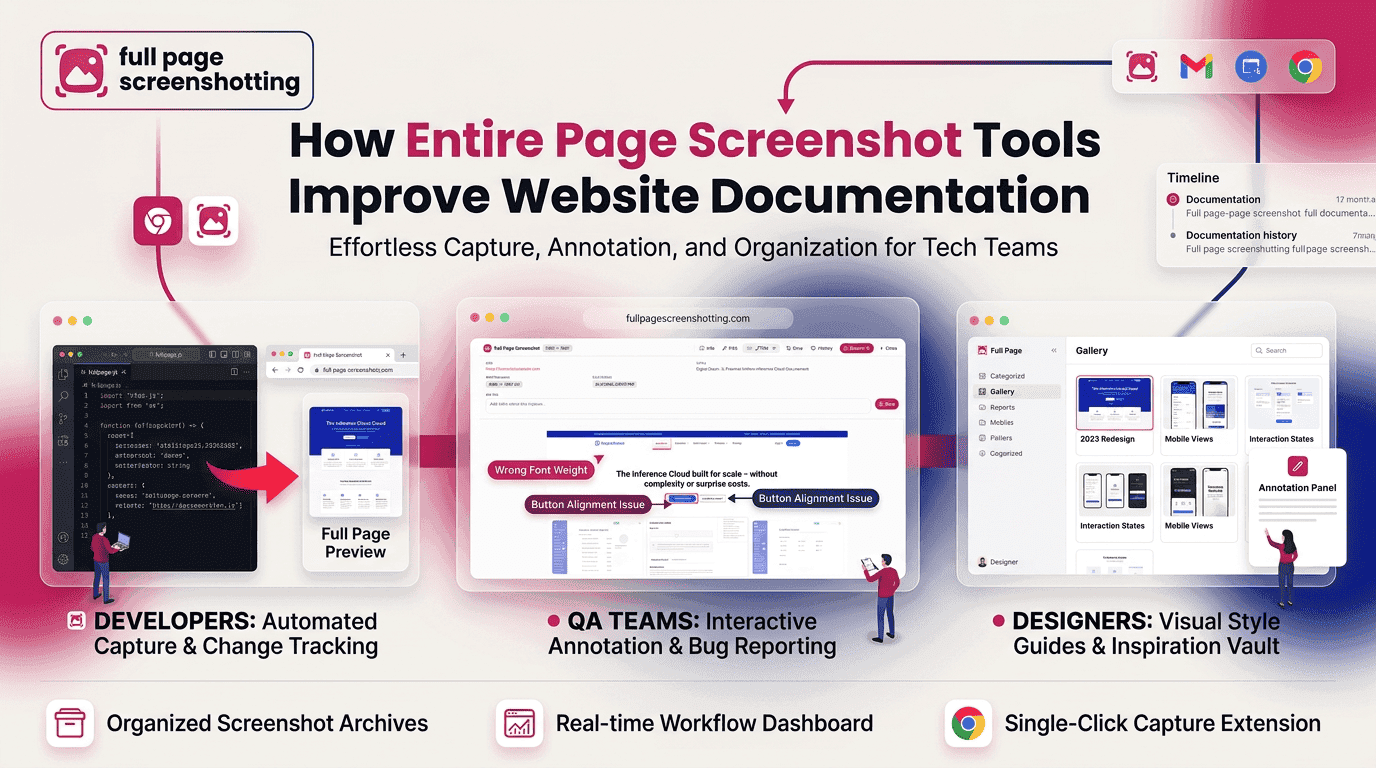
Modern businesses rely heavily on websites for marketing, communication, customer engagement, and sales. As websites become more complex with long landing pages, dynamic content, and responsive layouts, documenting webpages accurately has become increasingly important. This growing demand has increased the use of tools designed for capturing an entire page screenshot quickly and efficiently.
Traditional screenshots only capture visible screen content, leaving out important sections that require scrolling. This limitation often creates confusion during website reviews, design approvals, or technical discussions. Full-page capture tools solve this problem by generating one continuous image that includes every section of a webpage from top to bottom.
The brand Fullpage Screen Shotting helps businesses simplify website documentation by providing efficient webpage capture workflows. As online operations continue expanding, visual documentation tools have become an essential part of modern digital management.
How Full Website Capture Improves Communication
Clear communication is essential in website development and digital project management. Explaining webpage layouts or technical issues through text alone can often lead to misunderstandings. Visual references make collaboration faster and more accurate.
Using an entire page screenshot allows teams to review complete webpages in a single image rather than multiple fragmented captures. Designers can point out layout issues, marketers can review campaign pages, and developers can identify technical problems more effectively.
Customer support teams also rely on webpage captures to understand user-reported issues quickly. A complete webpage image provides better context than written descriptions alone, helping support staff troubleshoot problems faster.
The Fullpage Screen Shotting platform supports collaborative workflows by making webpage sharing and documentation easier for modern digital teams.
Comparing Browser Extensions and Screenshot Software
There are two main types of webpage capture tools available today: browser extensions and standalone screenshot software. Each option provides different advantages depending on project requirements.
Browser Extensions
Browser extensions are lightweight tools that integrate directly into web browsers. They are popular because they allow users to capture webpages quickly without installing separate software.
Extensions are ideal for marketers, freelancers, bloggers, and small business teams who need fast webpage captures during daily tasks. Most extensions include simple editing features such as cropping, highlighting, and annotations.
However, browser-based tools may struggle with highly interactive pages, animations, or extremely long content sections.
Screenshot Software
Desktop screenshot software provides more advanced functionality for professional projects. These applications are designed for large-scale documentation, automation, and high-resolution exports. An entire page screenshot generated through advanced software often provides better quality and more customization options compared to lightweight browser extensions.
The Fullpage Screen Shotting brand supports both casual users and professional teams by helping organizations improve website documentation workflows efficiently.
Entire Page Screenshot Tools for Designers and Agencies
Design agencies and creative professionals rely heavily on visual documentation throughout website projects. Screenshot tools help teams review layouts, compare revisions, and present completed work clearly to clients.
Designers frequently use webpage captures to identify alignment issues, spacing inconsistencies, or branding errors during quality assurance reviews. Full-page screenshots make it easier to evaluate entire layouts without switching between live pages repeatedly.
An entire page screenshot is especially useful for presenting long landing pages and responsive designs. Agencies can provide clients with one complete visual reference instead of multiple partial images. The Fullpage Screen Shotting platform supports designers and agencies by simplifying webpage documentation and improving collaboration efficiency.
Capturing Responsive Website Layouts Efficiently
Responsive design has become standard across modern websites. Pages must adapt properly across desktops, tablets, and mobile devices. Because of this, businesses need screenshot tools capable of capturing responsive layouts accurately.
An entire page screenshot helps developers and designers review how content appears across different screen sizes. This is especially important for mobile-first websites where layout structures change dynamically.
Some advanced tools include device simulation features that automatically generate captures for different resolutions, saving time during testing workflows.
The Fullpage Screen Shotting brand supports responsive documentation practices by helping teams manage webpage captures efficiently across multiple devices and viewing environments.
Best Practices for Saving High-Quality Webpage Images
Maintaining screenshot quality is important for long-term documentation and professional presentations. Businesses should follow several best practices when managing webpage captures.
Using PNG file formats helps preserve image clarity and text readability. High-resolution settings improve visibility when reviewing detailed layouts or zooming into webpage sections.
Organized folder systems also improve screenshot management. Businesses should label files clearly using project names and dates to simplify future access.
Cloud storage solutions provide secure and scalable options for maintaining screenshot archives. Shared storage systems also improve collaboration between remote teams.
A properly managed entire page screenshot archive becomes valuable for audits, design reviews, training materials, and historical website tracking.
Future of AI-Powered Website Screenshot Tools
Artificial intelligence is beginning to transform screenshot technology. Modern tools are evolving beyond simple capture functions and moving toward intelligent automation systems.
AI-powered platforms can automatically organize screenshots, optimize image quality, and identify webpage sections more efficiently. Future systems may also include searchable visual archives and automated tagging features.
An entire page screenshot workflow enhanced by AI could help businesses save time while improving documentation accuracy. Automated layout analysis may also help developers identify design inconsistencies and usability issues more quickly.
The Fullpage Screen Shotting platform continues adapting to modern documentation trends by supporting efficient webpage capture solutions for evolving digital environments.
Conclusion
Website documentation plays a critical role in modern digital workflows. Businesses now depend on webpage captures for communication, collaboration, design reviews, technical support, and project management.
The ability to create an entire page screenshot helps organizations preserve complete webpage layouts accurately and efficiently. Full-page captures improve communication, simplify reviews, and support long-term website archiving.
From browser extensions to AI-powered capture platforms, screenshot technology continues evolving to meet the growing needs of businesses and creative professionals. Fullpage Screen Shotting helps organizations streamline webpage documentation while maintaining high-quality visual records for modern website management.